Spotlight On... Chris Pak

26th August 2026
1. What aspect of REPAIR are you most involved in?
I co-lead on the Reflection (Futuring) thread.
2. What excites you most about this work?
As someone who lives in Swansea, having the chance to apply my expertise in science fiction to invite people to imagine and reflect on our shared futures and to collaboratively think through how we would like to shape those futures is, to me, an inherently exciting prospect.
3. What does biophilic living mean to you?
Nature, as Raymond Williams writes, is one of the most complex words in the English language, and I’ve spent most of my academic career unpacking the implications of this word. In a sense, biophilic living is a nature-based solution. But I don’t centre myself or even the idea of the human when I think about nature. And so while the virtues of the phrase ‘nature-based solutions’ for communicative purposes are real, I would prefer not to think with it. ‘Solutions’ implies that there is a problem that needs to be addressed, and I don’t think for me that biophilic living is best conceived that way: it already implies that the problem has been defined—both the what and the for-whom. ‘Nature-based’ seems to forget that humans are part of nature, too, and that all the objects and materials that we’ve created emerge from nature. For me, biophilic living needs to decentre the human—which I don’t take to imply an ignoring or downplaying of deprivation, social ills or cultural and social investments. Biophilic living involves the creation of spaces where different lives can intersect and flourish to the mutual benefit of all. This will look different depending on location, on which lives we’re talking about and the historical ways in which the land and human lives have been overwritten. The same is true for the forms of life that previously inhabited the spaces that have been urbanised: their displacement or the forms of adaptation that they’ve had to engage are so because they could not consent or otherwise to the transformations that undergird their lives.
“Biophilic,” however, needs to be interrogated, too. This is a word that names an affective response, an orientation to, a tendency toward “life” and “life-like processes,” and it sits in counterpoint with biophobic responses: negative orientations to the same. Both describe the different ways we orient ourselves toward specific constellations of “nature.” These words seem to me, once again, to set humankind off from the rest of the world. They encode a human experience. I wonder how hard it is to disentangle and de-prioritise human needs and desires from the needs of other lives. There’s a potential instrumentalisation of animal and plant lives, such that it’s not so much a living-with as it is a subordination of others to the needs and desires of humankind. This has very much been the case historically, and it’s very much one of the reasons we’re in the situation we find ourselves in now.
So, for me, biophilic living is living-with others in ways that make space for their otherness, and which compel us to work to sculpt ourselves to their needs.
4. Have your views on biophilic living changed since joining REPAIR?
I've certainly developed a greater understanding of how the word is being framed and used but my views haven't substantially changed to date. There's still much more time for that to happen!
5. What has been your most memorable REPAIR experience so far?
There are a number of memorable experiences. One of the workshops I developed for the project team, which involved a speculative role-play set over a hundred years in the future, was certainly one of them. As the only science fiction specialist working on the project it was exciting and rewarding to demonstrate to the rest of the team the potential for these creative approaches to reflexivity. Another experience of a very different kind was during an early tour of the Biome-under-construction. While on the roof, the sight of a kite hovering and eyeing us something like five meters away was astounding to me: I'd never seen a kite quite that close before, and certainly was surprised to see one there.
6. What is the most surprising thing you have learnt through the project?
I'm finding out more and more about Swansea. Through our collaboration with NRW I've had the chance to learn more about how water flows through the city, how its managed and some of the issues with water that has historically affected the city.
7. What do you enjoy most about working in a transdisciplinary team?
Learning about how other researchers in other disciplines work and what occupies them intellectually. I'm fascinated by ideas of many types and while I can't do everything myself, I don't have to: the beauty of working in a transdisciplinary team is that you have access to thinking that you wouldn't otherwise have.
8. What are your hopes for the future of REPAIR?
Fundamentally, I hope the project can bring together as many people in Swansea as is possible to work together to imagine how the city could be made even more fulfilling a place to live, and then to work together to make it possible. To me this is a utopian place-making endeavour.
9. Tell us about a place in nature that is important to you and why.
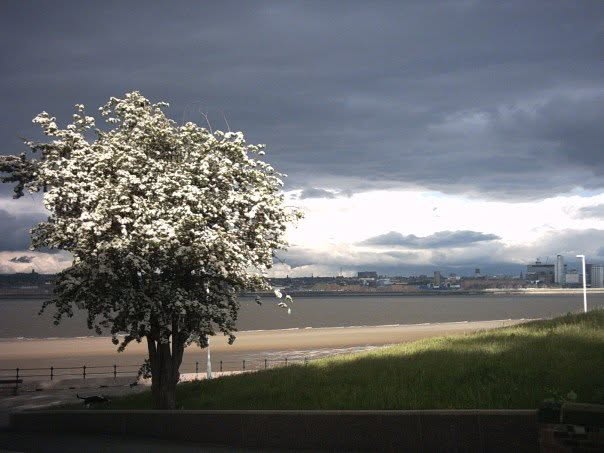
The Egremont to New Brighton promenade on the Wirral side of the Mersey. I used to live for a good number of years in Seacombe, right by the river, and would walk that promenade in the evenings with my brother quite frequently. It's where one of my favourite science fiction writers, Olaf Stapledon, used to live, too, and is the setting for some of the shots in Black's music video for "Wonderful Life". The sky is beautiful round the year there, particularly as it edges into Autumn. The coastal locale reminds me of growing up in Hong Kong. Seeing the life there and noting how the rhythms of the river changed over the year was always something that I enjoyed. A couple of times, when the right conditions came together, it looked as if there was a phosphorescence that curled at the edges of each wave as it rolled up the beach. I still walk that promenade when I visit the Wirral.