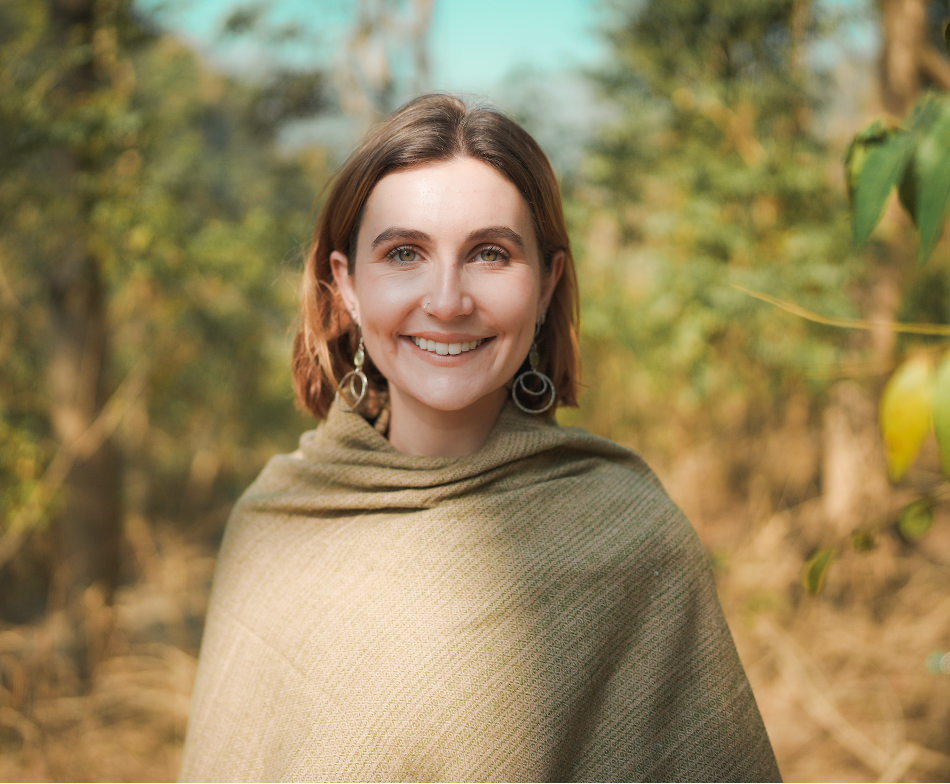
Spotlight On... Lowri Wilkie

3rd July 2026
1. What aspect of REPAIR are you most involved in?
I am most involved in planning and writing the psychology research for the Performance thread, bringing a psychological perspective to that strand of the work. I am also closely involved in the Perspective piece, the position paper that draws together the views of all the academics working on REPAIR into a single shared statement.
2. What excites you most about this work?
What excites me most is how creative and arts and humanities led the project is. Coming from a psychology background, REPAIR has really opened my eyes to different ways of doing academia. I have been especially struck by the creative approaches to workshops and futuring, inviting participants to imagine different climate futures, and by the emphasis on co-design and involving people directly in shaping the work.
3. What does biophilic living mean to you?
For me, biophilic living means an affiliation and connection to nature in a deep, relational way. It is about reconnecting with a part of ourselves that has been lost through modern life, and rebuilding that relationship rather than treating nature as something separate from us.
4. Have your views on biophilic living changed since joining REPAIR?
Yes, definitely. My thinking has shifted most around the idea that biophilic living cannot simply be designed and handed over ready made. It has to be created by the people who live there. Especially in an urban setting, it needs to be negotiated, shared, and discovered by residents themselves, through collaboration, rather than assumed to happen automatically once the building exists.
5. What has been your most memorable REPAIR experience so far?
My most memorable experience has been one of the creative futuring workshops we ran on one of our reflexive days. We were asked to imagine ourselves in the future, in a world where REPAIR had been really successful, and to picture what that world and its climate might look like. We worked in groups, almost role playing our way into that future together. It was good fun, but it was also a genuinely valuable piece of reflexive practice.
6. What is the most surprising thing you have learnt through the project?
The most surprising thing has been seeing how differently academics view the world depending on their starting point, something that becomes very clear once you work across disciplines that are usually taught in silos. In psychology, for example, there is often an instinct to intervene and change things, whereas in other disciplines the aim is not to manipulate but to observe. Noticing those differences has been really eye opening.
7. What do you enjoy most about working in a transdisciplinary team?
Again, it is the creativity, and the way working across disciplines unlocks new thinking in my own mind. I also think almost all of academia is moving in a transdisciplinary direction, so learning to work this way feels really important, both for this project and more widely.
8. What are your hopes for the future of REPAIR?
My hope is that the collaboration continues to go well, and that the residents in the Biome settle in and come to feel genuinely connected and affiliated with nature. More broadly, I hope REPAIR keeps deepening our understanding of what biophilic living really means. Most of us now live in urban environments, so I would love to see a future where we are all more relational and connected with nature, and finding practical ways to make that possible feels really important to me. I hope REPAIR continues to be part of that.
9. Tell us about a place in nature that is important to you and why.
A place in nature that matters deeply to me is the ocean, particularly along the Gower in Swansea, which is where the Biome building itself is. I have always lived by the sea, and I love swimming and surfing, so I feel a strong connection to the water. Looking out into the distance gives me a sense of being connected to the rest of the ocean, and to the rest of the world. I find it deeply healing.